
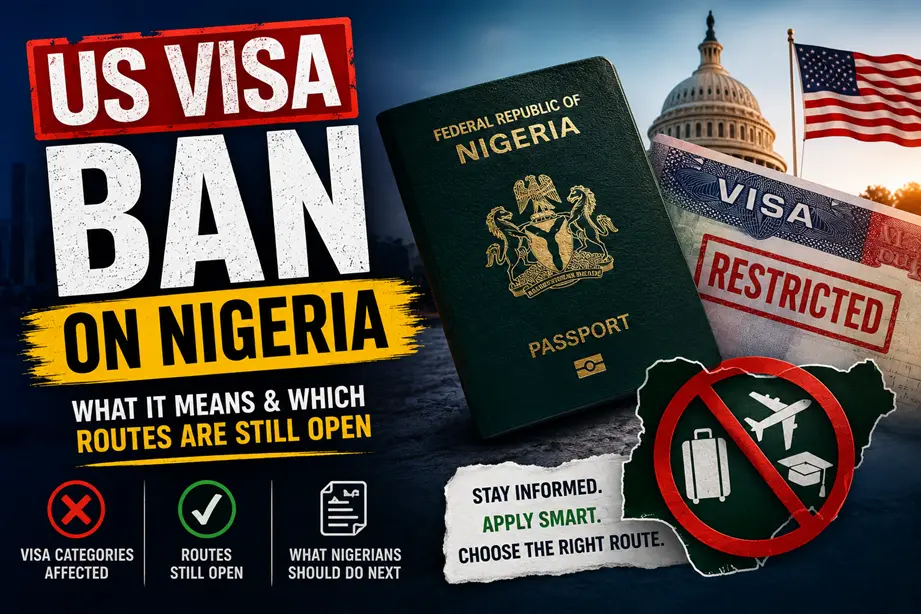
The recent discussions surrounding the US visa ban on Nigeria have created significant confusion for many Nigerian passport holders. Many applicants are asking important questions about which visa categories are affected, which routes are still available, and whether Nigerians can still move to the United States legally.
This guide explains the current situation surrounding the US visa ban on Nigeria, the visa categories commonly affected by travel restrictions, and the routes that may still remain available for Nigerian applicants.
The US Travel Restriction Tiers
| Tier | What It Means |
|---|---|
| Full Ban | All visa categories suspended for nationals of the affected country |
| Partial Ban | Some visa categories suspended, usually B1/B2, F1, M1, and J1 |
| Freeze | Applications may be accepted but not actively processed |
| Clear | No restrictions and normal visa processing |
Nigeria’s current status can be verified through the Emigrates Eligibility Wizard. The platform runs a live ban tier check against your passport country before showing available visa routes.
Because executive actions and immigration policies can change, applicants should always verify the latest updates before proceeding with any application.
Which US Visa Categories Are Commonly Exempt From Bans
H-1B Specialty Occupation Worker Visa
The H-1B visa is designed for professionals in fields such as information technology, engineering, finance, medicine, and other specialised industries. Applicants usually need a recognised degree, and a job offer from a US employer which comes with visa sponsorship. Even during periods involving the US visa ban on Nigeria, some employment based visa routes may still remain available.
O-1 Extraordinary Ability Visa
The O-1 visa is intended for individuals with extraordinary achievements in science, arts, education, business, and athletics. In some situations, applicants may self petition without employer sponsorship. Nigerian tech founders, entertainment professionals, and academics have successfully used this pathway.
L-1 Intracompany Transferee Visa
The L-1 visa allows multinational companies to transfer employees to a US office.
Applicants generally need employment with the company abroad for at least one year, and a qualifying relationship between both offices.
EB-1 and EB-2 Employment Based Residency
These categories are designed for priority workers and professionals with exceptional ability. In many cases, these employment based routes remain less affected during periods connected to the US visa ban.
EB-5 Investor Visa
The EB-5 visa involves investment in a qualifying US business. Typical investment ranges from $800,000 to $1,050,000. This category also remains largely unaffected in many travel restriction situations.
What Has Been Impacted for Nigerians
If Nigeria falls under a Partial Ban or Freeze category, the visa categories most commonly affected may include B1/B2 tourist and business visitor visas, F1 student visas, J1 exchange visitor visas, and M1 vocational student visas. However, this does not automatically mean Nigerians cannot travel to the United States. Instead, it means applicants may need to consider visa categories that continue processing despite the US visa ban on Nigeria.
Practical Next Steps for Nigerian Applicants
1. Verify Your Ban Tier Status
Before starting any application, check your current status through the Emigrate Eligibility Wizard. The tool performs a live check against your passport country and shows routes that may still remain available.
2. Identify Available Visa Categories
Applicants should confirm which visa categories are currently processing under their travel restriction tier. This can help prevent unnecessary applications and avoid wasting money on frozen routes connected to the US visa ban on Nigeria.
3. Strengthen Professional Based Applications
Applicants with professional qualifications, employer sponsorship, exceptional ability, and multinational company employment may consider employment based routes such as H-1B, O-1, and L-1.
4. Avoid Frozen Visa Categories
Applicants should avoid paying for applications that are currently suspended or frozen. This is especially important for categories that may be directly affected by the US visa ban on Nigeria, including some tourist, student, and exchange visitor visas.
Conclusion
The current discussions around the US visa ban on Nigeria have created uncertainty for many applicants. However, while some visa categories may face restrictions or delays, several professional, employment based, and investment pathways may still remain available.
Before applying, applicants should verify the latest travel restriction updates, confirm which visa routes are actively processing, and avoid spending money on frozen categories. Proper preparation and accurate information can help Nigerians make better immigration decisions during changing US immigration policies.